


X Ray Film
Your Professional X Ray Film Supplier
Jangsu Taike Medical Technology Co., Ltd. is located in Yangzhou, a famous historical and cultural city in China. It is a major production base and distribution center for disposable medical devices in China and enjoys the reputation of "Capital of Chinese Medical Devices".
The company independently researches and develops and produces medical dry film, medical dry laser film, cloud film, remote diagnosis, medical image printer, dry laser imager, radiology self-service film picker, ultrasound self-service film picker, "one-stop" all-hospital medical self-service film picker, etc., and is committed to providing hospitals with a one-stop solution for imaging output such as medical imaging, graphic reports, and medical films.


Parameter
|
Item |
Details |
|
Sizes |
8×10, 10×12, 11×14, 14×17 in |
|
Type |
Thermal / laser |
|
Base |
Blue polyester, 175 μm |
|
Packaging |
100 Sheets / box |
|
Carton |
5 Boxes / carton, 23 kg |
Features of X Ray Film

Composition
Screen X-ray films are designed to be used with intensifying screens. These films contain a base of polyester or cellulose acetate, coated with a layer of silver halide crystals suspended in an emulsion. The silver halides are activated by light emitted from the intensifying screens, which reduce the amount of radiation exposure required.

Sensitivity
Screen films are highly sensitive to light but less sensitive to direct X-ray exposure. The light emitted by the intensifying screens enhances the image formation process, allowing for lower radiation doses. Sensitivity can vary depending on the size of the silver halide crystals; larger crystals offer higher sensitivity but reduced image resolution.

Contrast Characteristics
Screen films offer a broad range of contrast levels. The contrast is determined by the type of screen and the film’s silver halide composition. Screen films typically have lower contrast than non-screen films but provide better image brightness.
Structure of X Ray Film
X-ray Film Comprises Seven Distinct Layers: A standard industrial X-ray film is approximately 0.5 mm thick and includes seven layers, with a transparent polyester or cellulose triacetate base at its core
Dual Emulsion Layers Enhance Sensitivity: Both sides of the base are coated with radiation-sensitive emulsion layers suspended in gelatine, effectively doubling the film’s speed and improving image capture
Protective Gelatine Layers Prevent Damage: Hardened gelatine layers are applied over the emulsion to protect against scratches and handling damage during processing and inspection
Substratum Layer Ensures Adhesion: A thin substratum layer bonds the emulsion to the base, ensuring structural integrity and consistent image quality across the film
Silver Halide Crystals Enable Radiation Detection: The emulsion contains microscopic silver halide crystals that react to ionizing radiation, forming the latent image that is later developed into a visible radiograph
Application of X Ray Film
General Radiography
Commonly used in chest, abdominal, and skeletal imaging.
Orthopedic Imaging
Ideal for capturing detailed images of bones and joints.
Lung and Heart Imaging
Used in chest X-rays to diagnose respiratory and cardiovascular issues.
Proper Methods For Organizing And Storing X-Ray Films
Vertical Storage
Upright Position: X-ray films should be stored in an upright (vertical) position, similar to how books are stored on a shelf. Storing films flat or stacking them can cause pressure and deformation, especially for large film stacks, which can lead to curling or warping over time.
Labeling and Indexing
Accurate Labeling: Ensure that all X-ray films are properly labeled with details such as patient name, date, and procedure type. Use permanent markers or preprinted labels to avoid the risk of smudging or fading.
Organized Indexing: Films should be organized in a systematic way, either alphabetically, by date, or by procedure type. This makes retrieval more efficient and helps reduce the handling of films, minimizing the risk of damage.
Secure Packaging
Durable Containers: Store X-ray films in sturdy, waterproof containers or cabinets to protect them from environmental factors, including accidental spills or physical damage. Ensure that the storage area is free from dust and pests that could compromise the quality of the films.
Packaging & Shipping
|
Item |
Description |
|
Packaging |
Neutral box + export carton |
|
OEM Box MOQ |
1,000 Boxes |
|
Sample Lead Time |
3–5 Days |
|
Bulk Lead Time |
7–30 Days |
|
Shipping Method |
Sea / Air / Express (Door-to-door) |
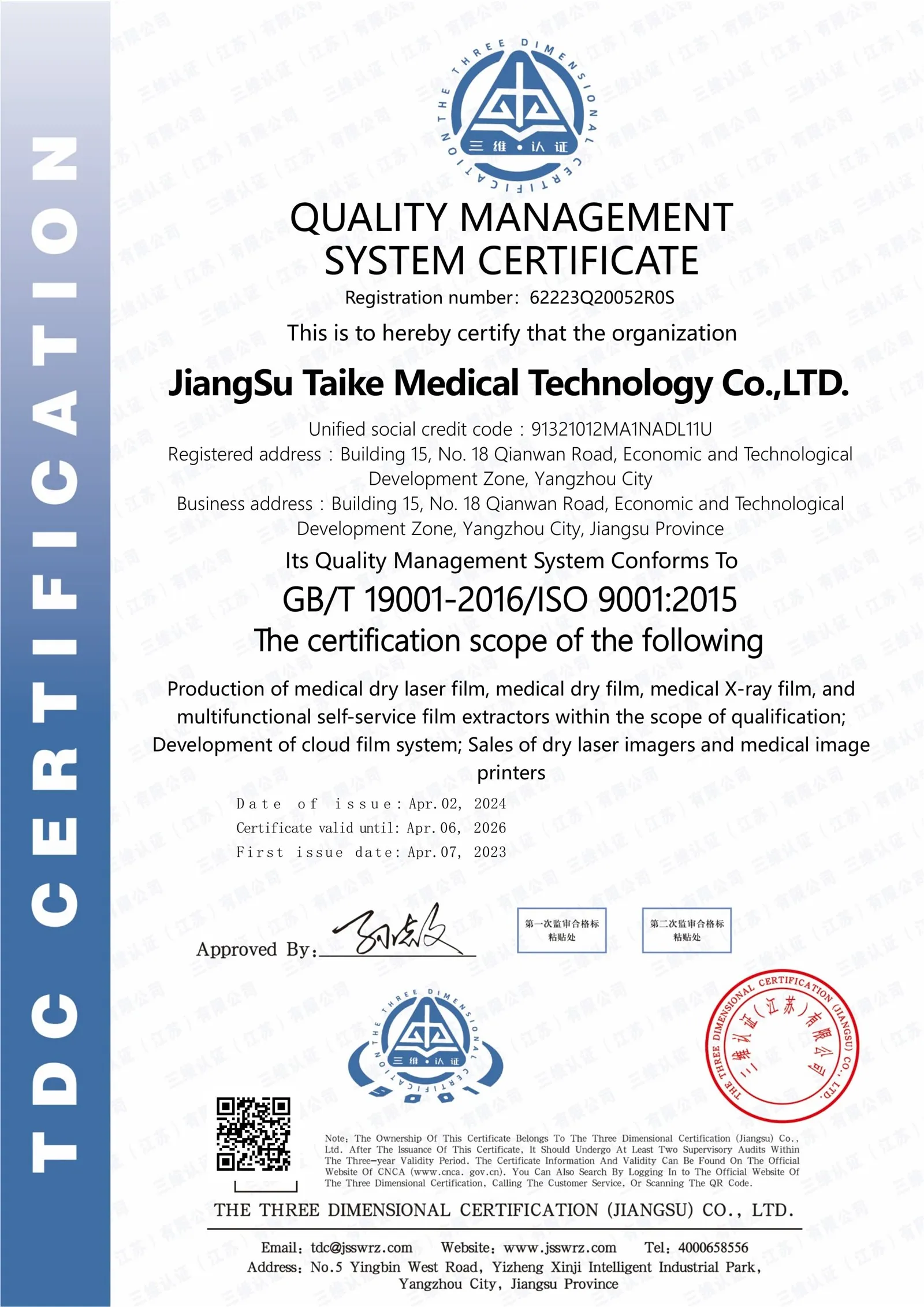
Certificate


FAQ
We're well-known as one of the leading x ray film manufacturers and suppliers in China. With abundant experience, we warmly welcome you to wholesale bulk high quality x ray film from our factory. We also accept customized orders.
Radiology Universal Dry Film, x ray film fogging, injectable x ray film